Sunday, 7 April 2013

hunting for a track


The enjoyment of many activities often begins with the planning and preparation, and hunting is a very appropriate example of this. For most hunters the anticipation of the hunt is as intoxicating as the action itself; acquiring and mastering new equipment, packing travel bags and gun or bow cases, reading every scrap of info about the quarry and hunting area, and lots of conversation with hunting kin, all in preparation of the adventure, whether it be a day outing or several weeks. Once the hunter reaches the destination, boots are on and nature surrounds, the hunt has begun.

For the Leopard hunter however the hunt only commences in earnest with the discovery of a suitable track. Weeks can pass travelling roads and checking game trails without success. Sundry prayers at hours of the morning when most are comfortably horizontal. And when that magical moment arrives and the familiar spoor of the elusive travelling cat is evident in the beam of the angled spotlights, you struggle to trust your eyes because it almost seems too good to be true.

Of course there are prime areas where Leopard population density is so great that in the course of a morning several tracks can enticingly be up for offer, but across the course of any committed Leopard hunters innings, those honey pots are a rarity.

So few tracks to pursue? ………………but why? ……………well because,  separate from the fact that the territorial cat usually requires an extensive area to satisfy the numerous essentials  for survival like a prey base, stalking cover, cub rearing habitat and a preferable low concentration of competing predators, to mention a few, the conscious Leopard hunter must also exclude all the intercepted female and sub-adult male tracks. What remains is a quarry that is estimated to be 8% of the total population – the mature male. Challenging.

This is one we had to pass up:


9cm measurement of the length of the front pad (including toes).


100cm stride - walking speed (exclude toes – top of the front pad to the top of the following front pad of the same paw).

Apart from the ‘roundness’ of the paw imprint and the absence of the ‘neat’ qualities of a females imprint, we can identify this track to belong to a sub-adult male due to the above measurements. A more mature male will measure at least 10cm and 115cm in these soil and ecological conditions.

It certainly was not a wasted morning and a stirring feeling of future expectation remains. Plus it is wonderful to know that no more than 48 hours previously the stealthy predator prince wandered down this path in search of a meal awarding opportunity.


Thursday, 14 March 2013

Tracking to a challenge


There is a renowned quote which reads something like: 
“One does not hunt in order to kill; on the contrary, one kills in order to have hunted…....If one were to present the sportsman with the death of the animal as a gift he would refuse it. What he is after is having to win it, to conquer the surly brute through his own effort and skill with all the extras that this carries with it: the immersion in the countryside, the healthfulness of the exercise, the distraction from his job”
Jose Ortega y Gasset

Well stated! ……in a modern world where the general public are more distracted from nature, than by nature, Jose’s written words will not be appreciated,  let alone comprehended. It is only those that accept and value the nature of the world, not man’s reconstruction of it, that can part from the concrete and steel and cyberspace and convenience and profit and feel at home and comfortable in the wilds.
It is my humble opinion that a progression in hunting is only to be achieved by the regression of the hunter. A shift away from technology and contemporary improvements. A graduation to the fundamentals…………Tracking.

The spoor of an animal can be followed visually by the trail of disturbance to soil and vegetation, or olfactorally by the deposited scent trail. Generally the best results are achieved through the harmonization of these two. Where the scent deposits are unavailable the visual party are responsible for the advancement of the course and visa/versa. No evident trail signals the end of the hunt. The polished skills of the cooperative and their concentrated efforts can result in success, but the natural playing field is vast, complicated and challenging, full of natural obstacles and puzzles.

However, the more challenging often equates to the most memorable. 
And so it was on this day:
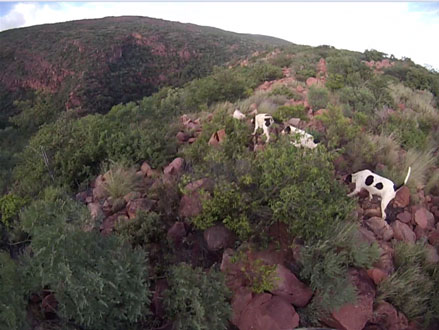
At 6am the hounds were directed to the track of a mature male Leopard. Progress was forcibly unhurried due to the intermittent soil conditions that only offered scent in select sections and visual tracks in other. We persisted until the trail entered a steep ravine where the scent line improved dramatically leading us to an impassable collection of boulders that only a Leopard could navigate.

Although we did not kill, we truly hunted.


Wednesday, 23 January 2013

Chasse aux Sangliers

More than One hundred years after this image was captured the passion for hunting Wild Boar has not waned in the first world country of France. In fact it could be argued that continuous efforts to manage a viable hunting population of Wild Boar has resulted in an expansion of the total population in  an ever decreasing natural habitat. As long as there are hunters committed to pursuing these species, so will a place be found for them in a modernizing world.


Sunday, 30 December 2012

Monday, 5 November 2012

True Hounds


Over the course of time hunting Man has fabricated, and further mastered the utilization of, many tools and aids to improve the regularity of his triumph over a chosen quarry. From stone arrow tips to core bonded projectiles, fragile wooden bows to carbon fiber compounds even elaborate trap falls to the Oneida Victor soft catch traps.

The hunting canine has accompanied man along this course for almost the entire journey, and likewise, has undergone significant change. From the wolf emerged the hunting dog and thereafter followed the broad diversity of modern hunting hounds and dogs.

But what is the difference between a hound and a dog you inquire?

Well it’s best to start with the image of a Jackal, Coyote or physically similarly constructed canines. Ears positioned high on the head to function like a radar dish, eyes clear and acute and a sensitive nasal organ in constant employ. This trio of senses is complimented by a powerful bite force capable of tearing flesh from a very much alive animal. The dog moves efficiently through the veld and investigates any promising sound, scent or movement. The pursuit is silent and often stalking techniques are engaged. Of the many species of predator the canines rank high on the list of success rate and their widespread dispersal and abundance are proof of this efficiency. Mastering these canines has benefited hunting man significantly as this weapon regularly delivered a source of protein.

History records a change in Mans hunting motivation toward a practice more aptly described as sport and the consequence for the canine was a program of selective breeding for specific physical and temperamental traits. Dogs were no longer required to acquire the meat but rather to function as a hunting aid and perform a pleasing task. Enter the Hounds, both sight and scent, the possession of which bestowed great esteem on owner’s right across the globe from Arabia to Western Europe. 
                 
The persisting theme of this paper will however only deal with scent hounds:

Great bawling voice, long drooping ears fastened to the head well below eye-line, elongated slender body, deep chest, obsolete bite force, sociable and responsive character and a passion for, actually an addiction to, the pursuit of scent, forms a basic but accurate description of what became the true scent hound. Lymers (leashed hounds) were the preliminary with numerous breeds now found prevalent on every continent of the modern world.

But How? And Why?   
                                                                                      
As hunting man placed more emphasis on the scent tracking ability of his canine tool so physical traits became more synonymous with individuals proficient in this task. Genetic flags, like your nose is the same as Granddads’ or big feet like your Uncle, were indicators that the individual might store the same good scenting abilities as previous descendants. Compounding these genes through processes of line-breeding and in-breeding resulted in a general uniformity and the start of hound breeds. Late 10th Century and a Belgian monk, later to be named the patron Saint of hunting, documented for the first time a breed standard, that of the Saint Huberts Hound or now commonly known as the Bloodhound. The St Hubert, and similar hounds, not only assisted the hunter to target a specific quarry by being unleashed onto a selected spoor, but also enabled him to pursue, on foot or horseback, by following the broadcast from the hounds bawling bark, and the sport of hunting entered some of its finest years in recorded history.

Hound hunting has now found its home in the pursuit of more elusive animals like pigs and cats but not limited to such. Diverse cultures and traditional practices are not as rich in the SA or USA hounding context as can be found in Europe but pioneer communities have always discarded a lot of the lace and embroidery for more practical measures. Traditions are often quite local in our fair land but the appreciation for the hounds ability and character can be experienced countrywide. So too is the general method of identifying the spoor of the target game and then orderly unleashing the pack onto the alluring scent track. Not every decoupling is successful but for the most part the joy of hearing the hounds hunt is prominent on the hunters agendas. The hunter performs the killing as has always been practiced in this discipline, initially with spear, sword or knife and nowadays the modern high powered firearm, since the start when the hound was fabricated to bay and not physically engage the stationary quarry. Although the hounds might be rewarded with parts of the carcass their enthusiasm for the hunt is to please their master and employ their finely selected genetic drives. Man has selectively molded the canine, in the form of the hound, so dramatically that it bears only a slight resemblance to its ancient ancestors - what predator advertises his pursuit so vocally to the quarry? This act is a complete demolition of the predator advantage.

Currently, around the world there are too many scent hound breeds to mention each individually but in France alone 23 Chiens Courants  are recorded and standardized. On every continent One can find scent hounds and in the USA alone there are more active hound hunters than the total amount of South African sport hunters. The elaborate large packs of the decadent eras are much less familiar now being replaced by economical, smaller packs, even to the extent that consideration in International hound hunting competitions for the categories of Solo and single Couple is most common.

Hunting is ingrained in SA culture for many and the sport is still well practiced and on a positive graph with the industry weathering the current economic storm comparatively well. This indicates a sturdy future and the popularity of hound hunting is growing respectively, especially among the hunters seeking a really interactive experience. 

Scenthound pups


Friday, 2 November 2012


TOOLS OF THE TRADE


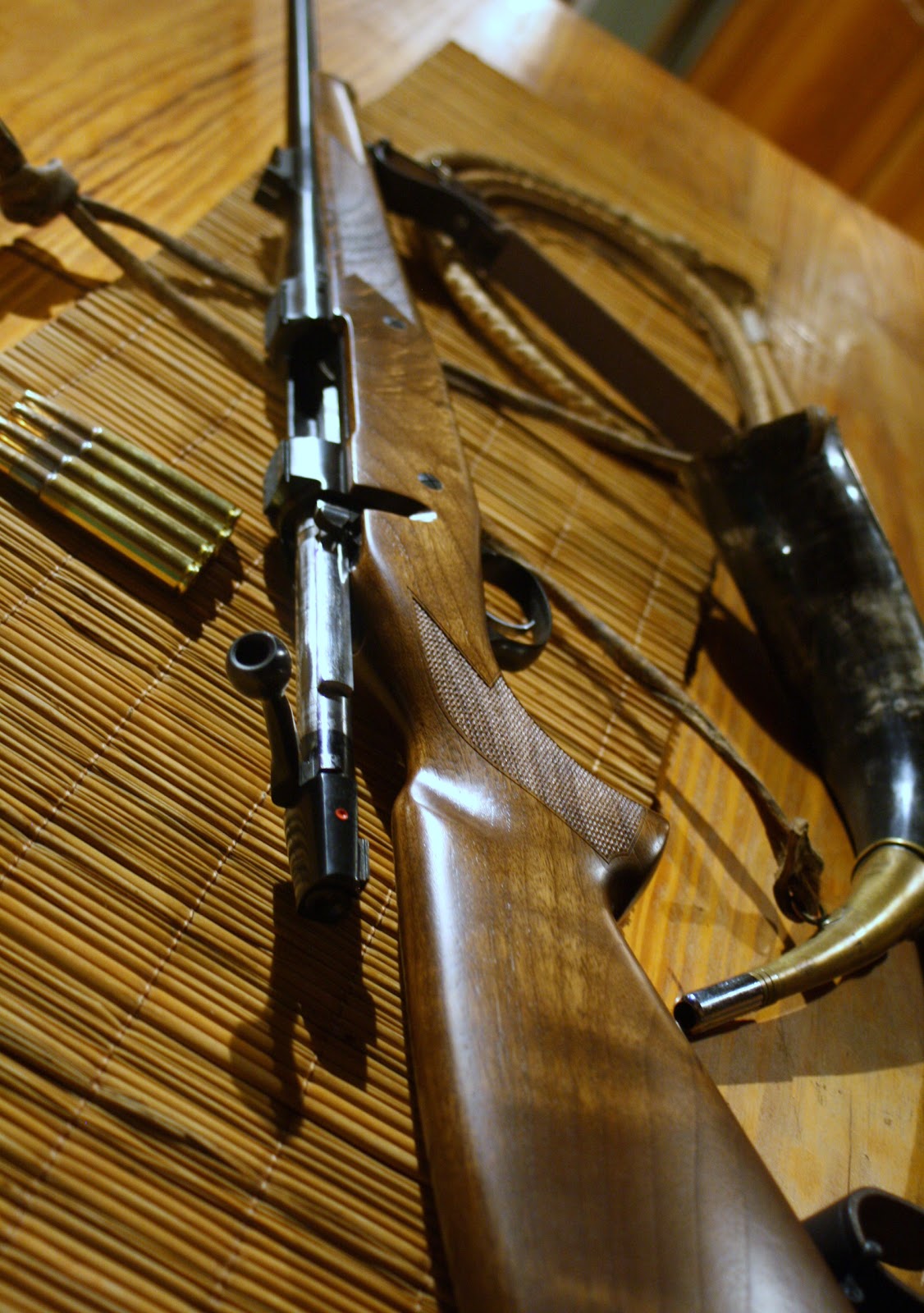
The .416 Rigby evokes the romance of the African safari like no other with the possible exception of the .375 Holland & Holland. Introduced in 1911 it was the first cartridge to use a .416” bullet. Sending a 400 gr projectile out at 2300 fps, the Rigby gets high marks in any comparison of stopping rounds. While its impressive dimensions demand a true magnum action, it is interesting to note that perhaps the most famous .416 rifle - that of PH Harry Selby - was built on a standard Mauser action. This CZ 550 is a variant of the true magnum Mauser properly proportioned to accept the modern big game cartridges.